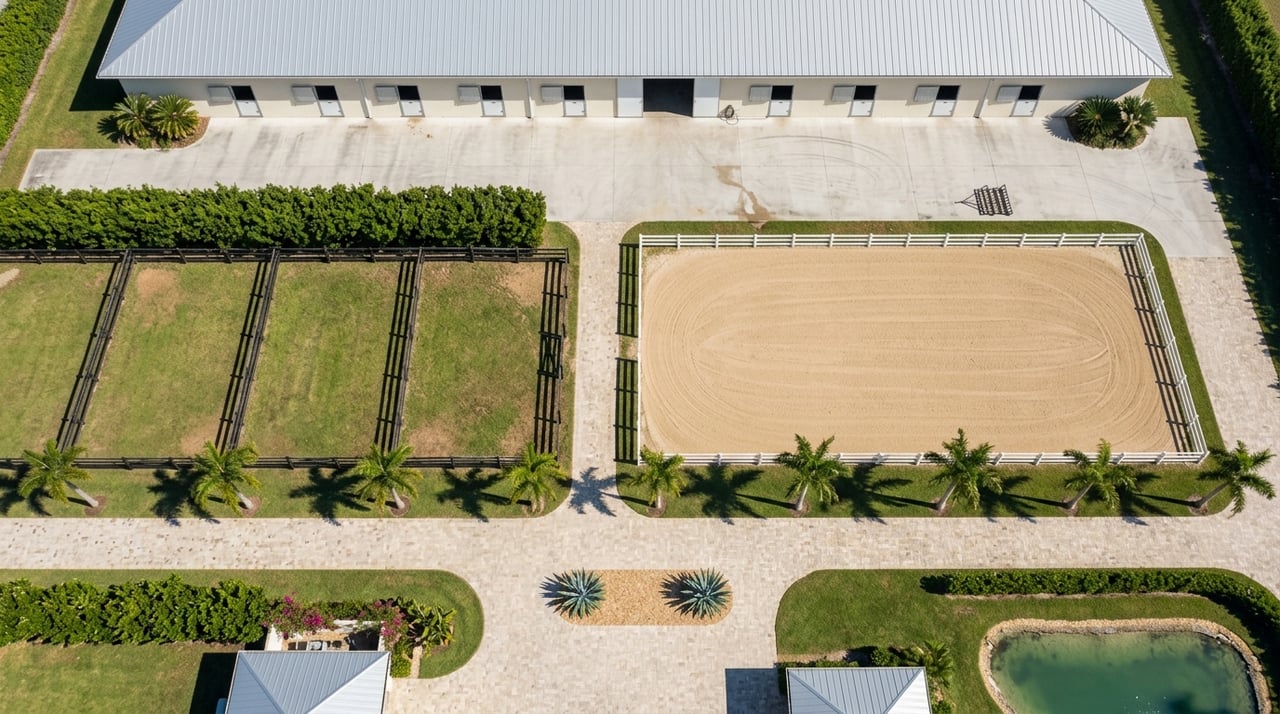
If you have ever wondered why two Wellington farms with similar acreage can carry very different price tags, the answer usually comes down to location. In this market, buyers are not just paying for land. They are paying for how smoothly a property works for horses, riders, staff, and daily competition life. This guide will walk you through the location factors that shape Wellington equestrian farm values so you can compare properties more clearly and make smarter decisions. Let’s dive in.
Why location matters in Wellington
Wellington is not a typical land market. The Village describes its Equestrian Preserve as an exurban environment built to keep horses close to the competitive core, with more than 57 miles of trails, more than 580 farms, and horse properties ranging from 1 to 200 acres. During peak season, the Village estimates nearly 13,000 horses are in Wellington, which helps explain why property value is tied to function inside the horse network, not just acreage alone.
The policy side matters too. Wellington has an Equestrian Overlay Zoning District and a long-standing focus on preserving its equestrian community, and the Equestrian Preserve Committee reviews issues such as land preservation, rider and animal safety, and flooding and drainage. For you as a buyer or seller, that means zoning certainty, usable infrastructure, and location within Wellington’s equestrian framework can all influence value.
Proximity to the showgrounds drives premiums
The strongest location premium in Wellington usually starts with access to the main competition venues. Wellington International identifies key venue points at Pierson Road, Equestrian Club Drive, and South Shore Boulevard, with the Winter Equestrian Festival running from January through March and Equestrian Village hosting the Adequan Global Dressage Festival during the same seasonal window.
That proximity matters because these venues are economic anchors, not just event sites. According to Wellington International’s 2025 impact report, the Winter Equestrian Festival generated $536.2 million in economic impact for Palm Beach County and drew 31,000 competitors from more than 50 countries and all 50 states. The same report notes long seasonal stays and substantial travel demand, which reinforces how tightly farm values connect to the competition calendar.
Village planning documents add another layer. They note that jumping and dressage account for roughly 85% of annual equestrian economic activity and that the showgrounds have outgrown their current footprint. Those same documents also point to the importance of hacking and golf-cart connectivity, which means a farm’s real value may depend less on straight-line distance and more on how easily you can get from barn to ring.
Access routes can change a farm’s value
A farm that looks well located on a map may feel very different in real life once you factor in trailer circulation, road surface, and daily congestion. Global Dressage Festival directions route drivers from Florida’s Turnpike and Interstate 95 toward South Shore Boulevard and Pierson Road, while Wellington International notes the area is about 20 minutes from Palm Beach International Airport, 45 minutes from Fort Lauderdale-Hollywood International Airport, and about 1 hour from Miami International Airport.
Those transportation links matter for riders, owners, staff, and horses moving in and out during season. They also matter for support teams, visiting clients, and service providers who need reliable access. In a high-performance equestrian setting, convenience is not just a luxury. It is part of a property’s daily utility.
The Acme Improvement District roadway overview highlights the main equestrian spine roads, including South Shore, Forest Hill, Big Blue Trace, Wellington Trace, 50th Street, Binks Forest, Flying Cow, Greenview Shores/Aero Club, Pierson, and Stribling. ACME also notes that some public roads in equestrian areas may be shell rock or compacted composition instead of fully paved surfaces. That can affect hauling, driveway wear, trailer maneuvering, and overall ease of use.
Planning documents for Wellington North go even further, noting that more than 90% of barn traffic is concentrated in certain core areas and that venue planning aims to reduce key vehicle-pedestrian conflict points. For buyers and sellers, that means road frontage, turn movements, crossing points, and route efficiency all contribute to the location premium.
Usable acreage matters more than raw acreage
In Wellington, bigger is not automatically better. The Village notes that while equestrian properties can range from 1 to 200 acres, common farm sizes are often 2 or 5 acres. That detail is important because the market tends to reward parcels that are efficiently laid out for barns, paddocks, arenas, parking, and circulation.
A well-configured 5-acre farm can outperform a larger property if the layout supports day-to-day horse operations. Buyers often care about whether the acreage feels practical, whether trailers can move cleanly through the site, and whether there is enough organized space for turnout, riding, and support uses. In other words, land that works well is often worth more than land that simply measures larger.
Drainage is also part of value. Wellington’s equestrian governance specifically reviews flooding and drainage, and ACME states that assessments support drainage, horse trails, preserve maintenance, roadway work, and other local infrastructure. That tells you something important about this market: value is tied not only to the parcel itself, but also to the systems that keep it usable through the season.
Amenities matter when they support horse life
In many markets, buyers focus on generic suburban amenities first. Wellington is different. Here, value often rises when a property connects efficiently to both the horse world and everyday living.
Village planning materials describe residents reaching equestrian events by walking, riding, or using golf carts. They also outline future support uses such as hospitality, retail, dining, wellness, golf, and tennis in the broader equestrian area. For a Wellington farm, the question is not simply what is nearby. It is whether nearby amenities fit the rhythm of equestrian life.
Wellington submarkets show major price differences
One of the clearest signs that location drives value is the sharp difference in per-acre pricing across Wellington submarkets. According to the 2025 Wellington Land Report from Atlantic Western, active and closed pricing varies widely depending on where a property sits and how it is improved.
Here is a simplified look at the directional pricing patterns in that report:
| Submarket | Directional Pricing |
|---|---|
| Grand Prix Village, Grand Prix South, Mallet Hill | Active listings averaging about $3.0M per acre |
| Saddle Trail | Improved sales averaging about $1.455M per acre, active listings around $2.305M per acre |
| Palm Beach Point, SunGlade Ranches | Improved pricing around $975K per acre, raw land around $610K per acre |
| Section 33 | Sales averaging about $498K per acre, active asks near $950K per acre |
These are brokerage-reported figures, not county assessments, but they are still useful directional markers. They show that the market is not pricing Wellington equestrian land as one uniform category. It is pricing each location based on access, utility, and submarket identity.
Brokerage examples support the same point. Atlantic Western highlights a 5-acre farm less than six miles from WEF that sold for $2.15 million and included a 9-stall barn, apartment, arena, paddocks, RV parking, and engineered drainage. The same source also shows a much larger 69-acre polo complex one mile from the showgrounds offered at about $427,536 per acre. The takeaway is simple: acreage alone does not determine value. Access and utility shape the number.
A practical way to compare farms
If you are evaluating Wellington equestrian properties, it helps to use a consistent framework. A farm may look impressive in photos, but the value picture becomes clearer when you compare how the property functions within Wellington’s equestrian network.
Start with these five questions:
- Which venue does the property best serve?
- What is the actual trailer route, and what is the road quality like?
- Is the parcel positioned within Wellington’s equestrian planning and zoning structure?
- How efficiently is the acreage configured for barns, paddocks, arena space, parking, and drainage?
- Does the asking price align with the right submarket rather than a broad countywide average?
This kind of analysis often explains why two similar-looking farms can differ by millions. Wellington buyers are usually not just buying land. They are buying time savings, operational ease, safer movement patterns, and stronger alignment with the competition ecosystem.
What this means for buyers and sellers
If you are buying, it helps to look beyond headline acreage and focus on how the property supports your actual program. A shorter, cleaner route to the venue, stronger drainage, and a more efficient site plan may create more long-term value than a larger parcel farther out.
If you are selling, the strongest marketing story usually connects location to function. That includes proximity to WEF or Global Dressage, road access, route simplicity, infrastructure, and how the farm fits into its specific submarket. In Wellington, sophisticated buyers tend to notice those details quickly.
When you want a clear read on how location affects a farm’s value, working with an advisor who understands both the technical side of equestrian property and the nuances of Wellington’s submarkets can make the process far more efficient. If you are considering a purchase, sale, or private evaluation, Matt Johnson offers a calm, informed approach shaped by real equestrian experience and deep local market knowledge.
FAQs
How does location affect Wellington equestrian farm values?
- Location affects value through proximity to the showgrounds, route efficiency, road quality, zoning context, and how well a property functions for horses and competition use.
Why is proximity to WEF important for Wellington farm prices?
- Proximity to WEF matters because the showgrounds are a major driver of seasonal demand, daily logistics, and overall equestrian economic activity in Wellington.
Do larger farms always sell for more in Wellington?
- No. In Wellington, usable acreage, layout efficiency, access, drainage, and improvements often matter more than total acreage alone.
Which roads matter most for Wellington equestrian access?
- Key equestrian access roads include South Shore, Forest Hill, Big Blue Trace, Wellington Trace, 50th Street, Binks Forest, Flying Cow, Greenview Shores/Aero Club, Pierson, and Stribling.
Are all Wellington equestrian submarkets priced the same?
- No. Brokerage data shows wide pricing differences across submarkets such as Grand Prix Village, Saddle Trail, Palm Beach Point, SunGlade Ranches, and Section 33.