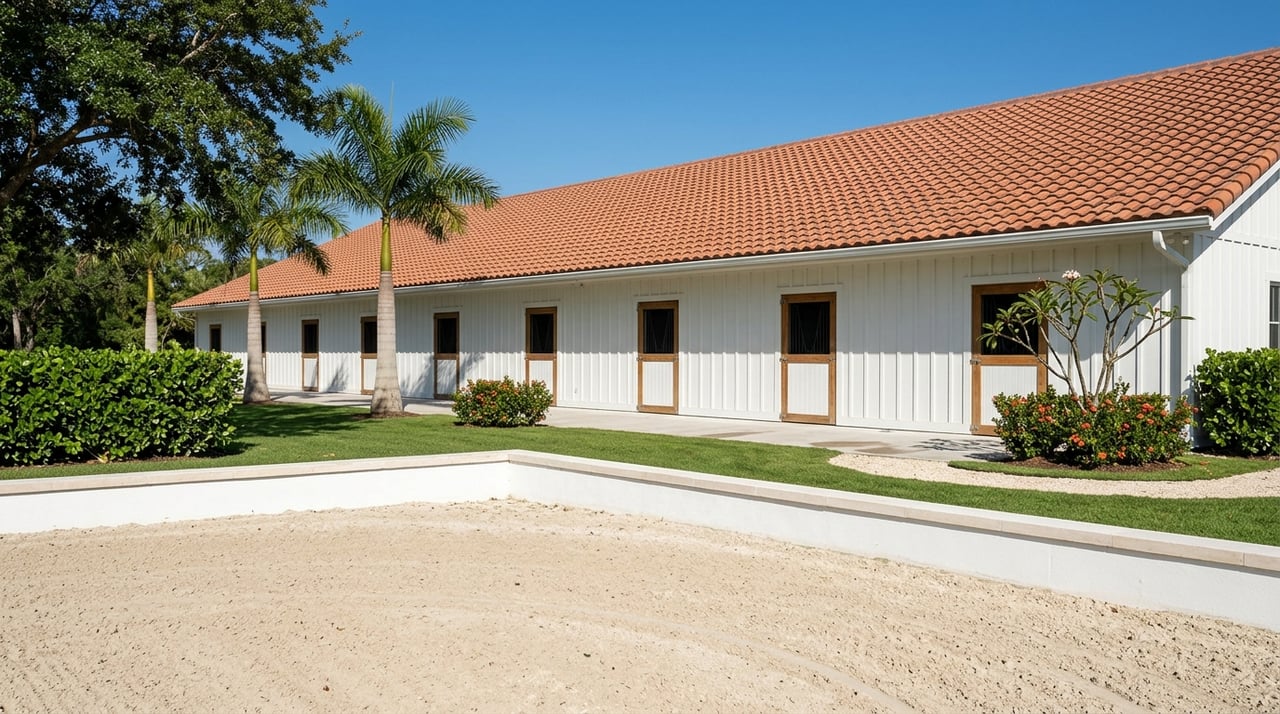
If you are buying for horses in Wellington, choosing the right area is not a small detail. It can shape your daily travel time, your barn setup, your turnout options, and how smoothly your entire program runs during the season. The good news is that Wellington has a clear equestrian structure, and once you understand the main area types, it becomes much easier to match location to your goals. Let’s dive in.
Wellington Works in Rings
One of the biggest mistakes buyers make is treating Wellington like one general equestrian market. In practice, it works more like concentric rings around a central venue cluster.
The Town of Wellington says the Equestrian Preserve Area is the land-use core regulated by the EOZD. It covers about 9,000 acres in the western and southern parts of town, includes more than 580 farms, and is supported by a large trail network. Horse farms range from 1 to 200 acres, with 2-acre and 5-acre parcels the most common.
That structure matters because your ideal location depends on what your program needs most. For some buyers, being close to the showgrounds is the priority. For others, barn scale, turnout, privacy, or trailer circulation may matter more.
Know the Venue Corridor
Wellington’s venue anchors are tightly grouped, and that is why location becomes such a practical decision. The main anchors include Wellington International at 3400 Equestrian Club Drive, the Equestrian Village at 13500 South Shore Boulevard, the competitor and administration building at 14440 Pierson Road, and the USPA National Polo Center at 3667 120th Avenue South.
Wellington International says it spans more than 200 acres, has 18 competition arenas, and hosts more than 40 weeks of horse shows. If your schedule revolves around frequent in-and-out trips, location inside or near this corridor can affect your day in a real way.
Choose by Program Priority
A simple way to think about Wellington is this:
- Choose the closest-in showgrounds ring when speed and convenience come first.
- Choose the semi-urban farm band when you want a balanced farm footprint with a manageable commute.
- Choose rural acreage areas when size, turnout, and privacy matter more than being next to the ring.
That framework gives you a starting point before you compare individual streets, parcels, and farm layouts.
Closest-In Areas Near the Showgrounds
For buyers who want to be near the center of competition activity, the closest-in ring is usually the first place to look. This is the area many people mean when they say they want to be “close to the horse show.”
Southfields and Nearby Communities
Southfields is one of the most recognized close-in options. A Wellington staff report says Southfields covers 197.7 acres with 89 units and 69 platted lots ranging from 1.15 acres to more than 4 acres.
That same report says Equestrian Club Estates spans 69.31 acres and includes 26 single-family lots, 39 zero-lot-line homes, and 34 attached duplexes on lots from 0.2 acres to 1.25 acres. It also says Mallet Hill is a 90-acre subdivision with 42 equestrian lots and a 1.25-acre minimum.
For a buyer, that means this ring offers several property types within a very compact geography. You may find estate-style equestrian lots, smaller lots, or residential formats that keep you very close to core venues.
Why This Ring Feels Different
This is not just a housing area. Wellington’s planning materials show that the corridor mixes residential, equestrian, polo, veterinary, and support uses rather than functioning as a purely residential neighborhood.
That mix is a major reason many serious equestrian buyers focus here first. Your day may involve not only getting to the ring quickly, but also managing staff movement, veterinary access, horse transport, and training logistics with less friction.
Grand Prix Village and the Showgrounds Edge
Planning documents for Wellington South show how valuable the edge of the showgrounds really is. The showgrounds are surrounded by Wellington International, Equestrian Club Estates, Mallet Hill, Palm Beach Point East, Southfields, and Grand Prix Farms, with future circulation designed to move riders by bridle path and golf cart rather than relying only on outside road traffic.
The same documents describe Wellington International as an 80-acre show venue with 18 arenas, 1,574 permanent and temporary stalls, bridle trails, pedestrian and golf-cart paths, restaurants, and shopping areas. Wellington North materials also note a former jumper showgrounds footprint that included a 9.75-acre FEI area with Grand Prix Village.
In practical terms, this submarket is compact, venue-driven, and highly operational. If your season revolves around repeated trips to competition venues, this location can be hard to replace.
Support Services Matter Too
The closest-in corridor also functions as a support-services node. A staff report says Grand Champions Polo Club has five practice polo fields, and Palm Beach Equine at Pierson and Southfields has nine barns with a total of 355 stalls.
That kind of surrounding infrastructure is important if your program spans more than one discipline or depends on close coordination. Buyers often focus first on the home or barn, but the surrounding service ecosystem can be just as important to how well the property performs for daily use.
Semi-Urban Areas With More Flexibility
Not every program needs to sit on top of the showgrounds. Some buyers want more land and working farm utility while still keeping a reasonable route to Wellington’s main equestrian venues.
That is where the semi-urban band often makes sense.
Paddock Park and Saddle Trail Park
Acme classifies Paddock Park and Saddle Trail Park as the 1.5-acre to 5-acre semi-urban band. This category can appeal to buyers who want a real farm footprint without moving all the way into the larger rural acreage areas.
Acme also notes that Saddle Trail Park has its own neighborhood improvement district and that Acme’s maintenance, storage, and law-enforcement facilities sit on a 12-acre parcel in the Saddle Trail Park area south of Greenbriar Boulevard. It also says equestrian roads in the district can be unpaved shell rock or compacted composition, and that bridle trails are maintained for safe riding conditions.
For you, this creates a useful middle ground. You may gain more property functionality while staying connected to Wellington’s equestrian circulation network.
Grand Prix Farms and Wellington CountryPlace
Acme also places Grand Prix Farms and Wellington CountryPlace in the semi-urban category. Wellington planning documents place Grand Prix Farms west of the showgrounds corridor.
That positioning can be appealing if you want meaningful horse infrastructure while staying closer to Pierson Road and South Shore Boulevard than you might from farther west or south acreage. In other words, you may be able to balance commute time with a more practical farm layout.
Rural Areas for Size and Privacy
If your program needs larger barns, more turnout, more separation, or a more private feel, Wellington’s rural acreage areas deserve serious attention. These locations are often the better match when the property itself is the main priority.
Palm Beach Point
Palm Beach Point is classified by Acme as a 5-acre-or-greater rural category. The district map identifies it as Unit of Development No. 2, created in 1978 with 1,500 acres.
Wellington planning documents place Palm Beach Point East south of the showgrounds corridor. For buyers who need larger barns, additional turnout, and more separation from show-day traffic, this area is often an obvious fit.
Little Ranches and Land South of Pierson
Acme’s rural OAD category includes Little Ranches and all land south of Pierson Road, excluding sections 20 and 21. These areas can offer a more private and expandable feel, especially for programs that value space over immediate showgrounds proximity.
At the same time, a rural purchase usually calls for a closer look at the property’s operating details. Trailer access, delivery circulation, drainage, and surface maintenance can have a larger impact here than they do in more compact locations.
Logistics Should Guide the Search
Wellington’s planning framework makes clear that rider logistics are part of land use, not an afterthought. The Equestrian Preserve Committee advises on rider safety, flooding, drainage, and land-development decisions, and the town says the trail system supports recreation, exercise, and transportation throughout the community.
Acme also says road ownership and maintenance vary by area. Its acreage-based assessment structure means carrying costs and infrastructure expectations can change as you move from urban to semi-urban to rural bands.
That is why two properties with similar acreage can function very differently in day-to-day use. The right choice is not only about how beautiful a farm looks, but how efficiently it supports your horses, staff, trailers, and competition schedule.
A Practical Way to Decide
If you are narrowing your search, start by ranking these three questions:
- How important is immediate access to the showgrounds?
- How much farm footprint do you really need?
- How much do privacy, turnout, and separation matter to your program?
If your answer to the first question is “very,” then the showgrounds ring may be your best fit. If you need a balanced setup with usable acreage and a manageable route to the venue cluster, the semi-urban band often makes sense. If the property must support larger-scale operations or a quieter setting, Palm Beach Point or other rural west and south Wellington areas may be the stronger choice.
Why Local Guidance Matters
In Wellington, small location differences can create big lifestyle and operating differences. One road may suit golf-cart and bridle-path movement better, while another may make more sense for barn scale, privacy, or truck and trailer flow.
That is why buyers benefit from guidance that goes beyond square footage and price per acre. When you understand how a property functions in relation to the venue corridor, support services, trails, and infrastructure, you can make a far more confident decision.
If you are weighing Wellington options for a competition barn, private farm, or equestrian-capable estate, a measured local search can save time and help you focus on the areas that truly fit your program. When you are ready for a discreet, technically informed conversation about Wellington equestrian property, request a private consultation with Matt Johnson.
FAQs
What is the best Wellington area for frequent horse showing?
- If your program is centered on fast access to Wellington International and nearby venues, the closest-in showgrounds ring, including areas such as Southfields, Equestrian Club Estates, and Mallet Hill, is usually the most convenience-driven choice.
What are semi-urban equestrian areas in Wellington?
- Acme classifies Paddock Park, Saddle Trail Park, Grand Prix Farms, and Wellington CountryPlace in the semi-urban band, which generally offers a middle ground between close-in convenience and larger rural farm layouts.
Where should you look for larger equestrian acreage in Wellington?
- Palm Beach Point and certain rural areas south of Pierson Road are the clearest options when your priorities include larger parcels, more turnout, and a more private setting.
Why does Wellington location matter so much for horse properties?
- Wellington’s equestrian market is organized around a compact venue corridor, trail connections, and varying road and land-use patterns, so location can directly affect commute time, circulation, support access, and overall daily efficiency.
What is the Equestrian Preserve Area in Wellington?
- The Town of Wellington says the Equestrian Preserve Area is the town’s equestrian land-use core, covering about 9,000 acres in the western and southern portions of Wellington and including more than 580 farms.
How do parcel sizes vary across Wellington equestrian areas?
- Wellington says horse farms in the Equestrian Preserve Area range from 1 to 200 acres, with 2-acre and 5-acre parcels the most common, while specific areas may include smaller residential lots, semi-urban parcels, or larger rural acreage depending on location.