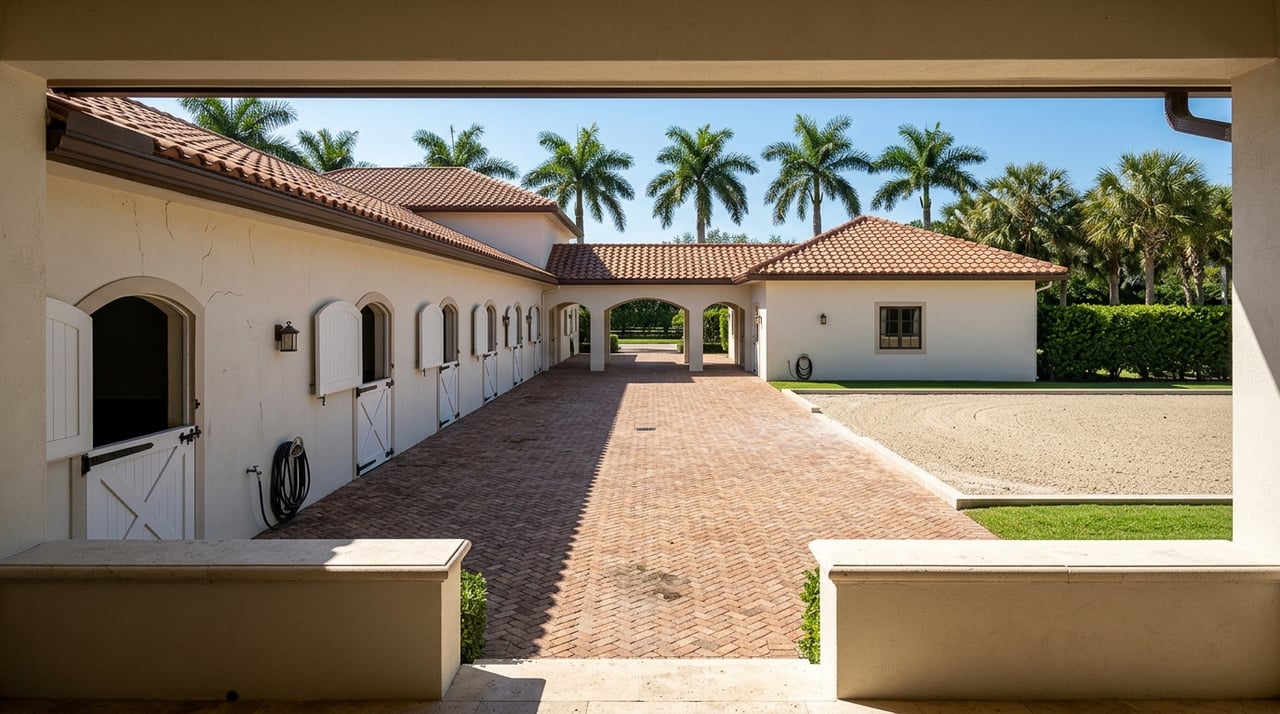
If you are deciding whether to build or buy a Wellington training farm, the real question is not just cost. It is timing, usability, and how well the property supports your program inside one of the country’s most structured equestrian markets. In Wellington, local zoning, drainage, trail access, and the winter competition calendar all shape the decision, so understanding those moving parts can save you time and expensive surprises. Let’s dive in.
Why Wellington is Different
Wellington is not a typical South Florida equestrian market. The Village identifies its equestrian core as the Equestrian Preserve Area, or EPA, which is regulated by the Equestrian Overlay Zoning District. The EPA covers about 9,000 acres in the western and southern parts of the village and includes Wellington International, the National Polo Center, more than 100 miles of bridle trails, and a wide mix of equestrian farms and facilities.
That matters because your buy-versus-build decision happens inside a purpose-built equestrian district with its own rules and expectations. What works on paper in another market may not translate cleanly in Wellington. Here, layout, access, drainage, and code compliance are part of the strategy from day one.
Why Timing Matters So Much
For many owners and trainers, the winter season drives the entire timeline. Wellington International hosts more than 40 weeks of horse shows, including 13 weeks of the Winter Equestrian Festival and 10 weeks of the Adequan Global Dressage Festival. The busiest stretch runs from January through March.
If you need a farm ready for that window, even a modest delay can disrupt horse movement, staffing, scheduling, and income planning. That is why the speed of occupancy often becomes just as important as the purchase price or construction budget.
Buying a Wellington Training Farm
Buying usually gets you operational faster
Buying an existing training farm is often the quicker path to usability because the main infrastructure is already there in some form. Barns, arenas, paddocks, drive aisles, and service areas may already be in place, which can make it easier to align with an upcoming season.
In Wellington, that speed advantage is meaningful. If your goal is to be functional by the next winter circuit, buying can reduce the risk of getting stuck in approvals, site work, and construction delays.
Fit matters more than just appearance
The biggest benefit of buying is operational fit. You can assess whether the property works for your actual program, whether you need a large training setup, a boutique operation, or a more private equestrian estate.
A beautiful farm is not always the right farm. Stall count, horse flow, trailer circulation, arena placement, storage, turnout, and service access all affect how smoothly the property functions day to day.
Existing improvements can hide expensive limitations
The main tradeoff with buying is that you inherit earlier site decisions. Some of those choices are easy to update, but others can be costly if they involve drainage, grading, fill, utilities, or access improvements.
Wellington’s engineering permit checklist specifically identifies fill or excavation, paving, grading, drainage improvements, right-of-way connections, culverts, irrigation connections, and utility work as permit-relevant activities. In simple terms, changing the land itself can become a bigger project than many buyers expect.
Due Diligence Before You Buy
Confirm land use and zoning
One of the first things to verify is whether the property’s future land use and zoning align with your intended use. Palm Beach County states that future land use and zoning must be consistent when developing property, and zoning controls standards such as setbacks, landscaping, and parking.
That means the visible improvements do not tell the whole story. A farm may look functional, but the parcel’s legal framework still needs to support your plans.
Review drainage and flood exposure
Drainage is not a minor issue in Wellington. The village’s Equestrian Preserve Committee specifically advises on flooding and drainage in the EPA, and Palm Beach County notes that structures in FEMA flood zones must comply with flood regulations.
Before closing, pay close attention to low spots, water flow, fill history, and how the site handles heavy rain. Those factors affect usability, maintenance, and future improvement costs.
Study access and trail compatibility
Access is another core operating issue. Wellington’s code allows the village to require bridle trail easements for a principal equestrian structure or use, and local rules also address arena appearance, fence types, and dressage-wall screening.
That means trailer circulation, trail connections, and fence layout should be treated as practical business issues, not just design details. If the access pattern is awkward, daily use becomes harder long after the closing date.
Building a Wellington Training Farm
Building gives you control
If you already know exactly how you want the farm to work, building from the ground up gives you the most control. You can shape stall count, barn layout, arena dimensions, horse circulation, storage, staff areas, and the overall presentation of the property.
For some owners, that level of customization is worth the extra time and complexity. A purpose-built farm can support your discipline, staffing model, and long-term brand more precisely than a retrofit.
New construction brings a heavier approval path
The tradeoff is that building in Wellington involves more entitlement and site-work complexity than many buyers first assume. The village’s permit checklist states that land development permits apply to new development and redevelopment, with limited exceptions for certain smaller residential or rural equestrian situations.
For a training farm, the timeline is not just about how fast builders can work. It also depends on how quickly site plans, approvals, engineering review, and inspections move through the process.
Fees and permit timing affect the budget
Wellington outlines a formal fee and review structure for land development permits. The village lists a $1,000 land development permit application fee, a 4 percent permit fee based on the approved cost estimate, and a 24-month permit expiration.
Those details matter when you build your timeline and budget. Carrying costs, consultant time, and approval windows can influence the total project just as much as materials and labor.
Agricultural Exemption Questions
Do not assume an exemption applies
Palm Beach County states that bona fide agricultural building activity on properly zoned land can qualify for a building-permit exemption under Florida Statute 604.50. The property must be classified as agricultural by the Property Appraiser, and the county charges a $200 exemption-review fee.
For a commercial training farm, that exemption may or may not apply depending on how the use is structured. The key is to confirm eligibility early rather than building a plan around an assumption.
Local Design Rules Can Shape the Project
Wellington’s equestrian code affects more than aesthetics
Wellington’s local rules can influence both cost and design. The EOZD states that the village may require bridle trail easements, roofed equestrian arenas must match the principal structures in architectural style, color, and materials, dressage walls require at least a one-acre lot and must be screened from public view, and certain fence types must be screened while barbed wire is prohibited.
For commercial sites, the code also says equestrian circulation and holding features should be integrated into the design. In practice, that means a new farm is not just a barn and an arena placed on vacant land. It is a coordinated site plan.
Some improvements are treated differently
Wellington’s code defines equestrian amenities broadly, but it excludes lighting standards and seating from that definition. That distinction can matter when you plan a facility because not every equestrian-related feature is treated the same way under local rules.
The lesson is simple: scope matters. Seemingly secondary improvements can affect review, permitting, and cost.
Buying vs. Building by Business Goal
When buying makes more sense
Buying is usually the better fit if you need speed, continuity, and less construction uncertainty. It is often the practical choice for trainers or owners who need to move horses in quickly and be ready for the next January-to-March show cycle.
The compromise is that you may need to accept existing footing, circulation, drainage patterns, or layout choices that are not perfect. In Wellington, buying is often the speed-and-certainty option.
When building makes more sense
Building is often the stronger strategic fit if you have a longer runway and a very specific vision. It allows you to design around horse count, discipline, staffing, circulation, and the overall image of the farm.
That path works best when you plan backward from the winter season and give real weight to approvals, engineering, and code compliance. In Wellington, building is usually the control-and-customization option.
A Practical Way to Decide
If your top priority is being operational soon, start by evaluating existing farms with a sharp focus on zoning, drainage, access, and how the property actually functions for your program. A farm that works today can be more valuable than a perfect concept that is not ready in time.
If your top priority is long-term precision, branding, and a highly specific layout, building may create the better result. The key is to treat land development and local rules as part of the farm itself, not as side issues to solve later.
In Wellington, the right answer often comes down to one question: do you need to be ready for the next season, or are you building for the next decade?
If you want a clear, technically informed view of what makes a Wellington training farm work in the real world, Matt Johnson can help you evaluate land, existing facilities, and acquisition strategy with the perspective of both an advisor and an active equestrian.
FAQs
What makes Wellington different for a training farm purchase or build?
- Wellington’s equestrian core sits within the Equestrian Preserve Area and is regulated by the Equestrian Overlay Zoning District, which adds local rules around development, access, and design.
Is buying a Wellington training farm usually faster than building?
- Yes. Buying is usually the faster path to usability because the core infrastructure already exists, which can matter if you are trying to align with the winter competition season.
What should you verify before buying a Wellington equestrian property?
- Confirm future land use and zoning, review drainage and flood exposure, and study trail access, trailer circulation, and fence or arena compatibility with local rules.
Do drainage and utility work matter in Wellington farm permitting?
- Yes. Wellington’s permit checklist identifies fill, grading, drainage improvements, culverts, irrigation connections, right-of-way connections, and utility work as permit-relevant site activities.
Can a Wellington training farm use an agricultural permit exemption?
- Sometimes. Palm Beach County says bona fide agricultural building activity on properly zoned, agriculturally classified land can qualify, but eligibility should be confirmed early.
How long does a Wellington land development permit last?
- Wellington’s permit checklist lists a 24-month permit expiration.
Does Wellington regulate trail access and farm appearance?
- Yes. The local code may require bridle trail easements and also addresses arena appearance, fencing, and dressage-wall screening.
When does building a Wellington training farm make the most sense?
- Building usually makes the most sense when you have a longer timeline and need full control over stall count, layout, circulation, arena design, and overall farm function.