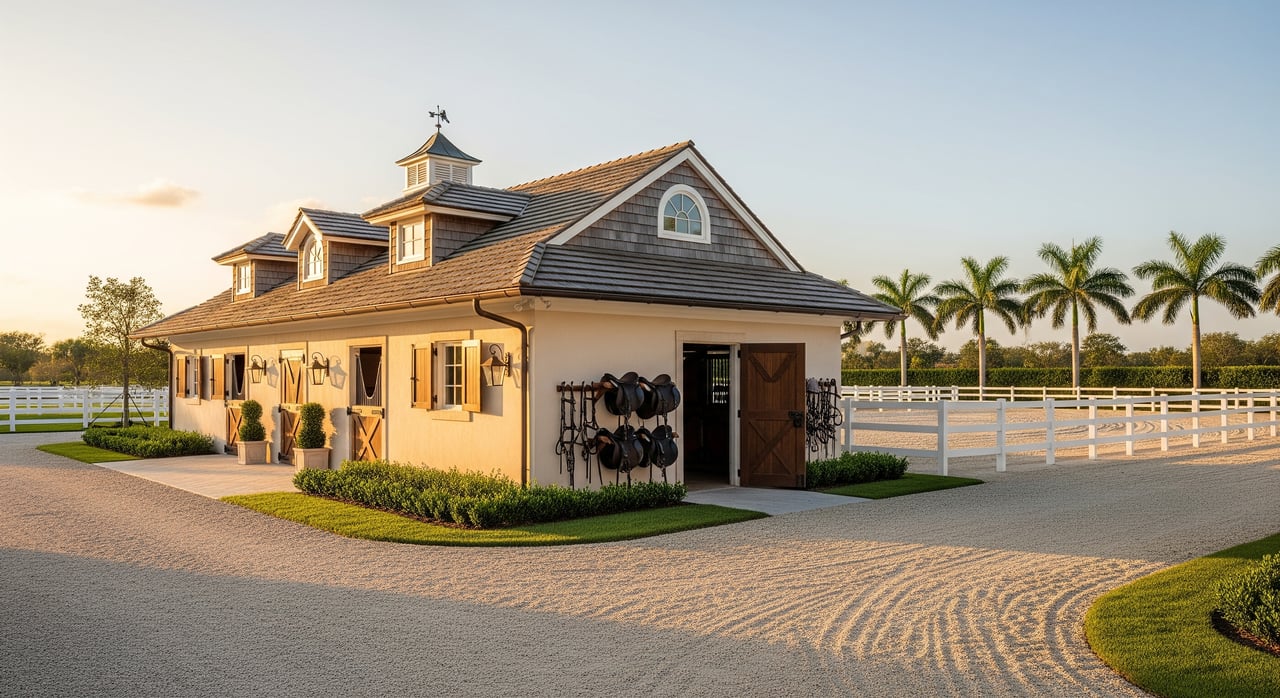
Shopping for a Wellington equestrian estate can feel thrilling and overwhelming at the same time. The barn is the heart of your operation, and small oversights can turn into costly fixes in Florida’s heat, storms, and strict water-protection environment. This guide gives you a clear, technical checklist tailored to Wellington so you can evaluate barns with confidence and plan upgrades smartly. Let’s dive in.
Wellington rules and risk checks
Wellington barns sit within Palm Beach County and are subject to the Florida Building Code, Florida Fire Code, and local planning, zoning, and permitting. You should verify that the structures, uses, and improvements were properly permitted and that occupancy classifications fit how you plan to use the property. Ask for copies of permits and any open code cases.
Hurricane and flood exposure matter. Confirm wind-load and anchoring details with local officials, and check floodplain maps for insurance and build standards. Drainage is a top priority in South Florida, so walk the site after rain if possible and map runoff paths.
Water quality and runoff management are regulated at state and local levels. Wash-rack water, paddock runoff, and manure storage need compliant handling. Coordinate early with the Village of Wellington, Palm Beach County, the South Florida Water Management District, and the Florida Department of Environmental Protection to understand rules and best practices.
Action items:
- Confirm permits, zoning, and use classifications for all equestrian structures.
- Check flood status, wind zone, and hurricane-related build standards.
- Verify water source, septic or sewer, and any irrigation wells and their permits.
- Ask about local manure-hauling service capacity and pickup schedules.
Stalls and aisle fundamentals
Stall sizes and clearances
Match stall sizes to your horses and program. As planning ranges:
- Minis and ponies: roughly 8 to 10 feet square.
- Light riding horses: 10 to 12 feet square.
- Standard performance horses: 12 x 12 feet is a common baseline.
- Larger warmbloods or extra comfort: 12 x 14 or 12 x 16 feet.
- Stallions or draft types: 14 x 14 to 14 x 16 feet.
- Foaling or mare-and-foal: 12 x 18 up to 12 x 24 feet or larger.
Aim for stall doors about 7 to 8 feet high, and main aisles 10 to 14 feet depending on equipment use. Wider aisles boost safety and workflow. Stall doors 4 to 4.5 feet wide improve passing; 5 feet is helpful for mares, foals, and stallions.
Flooring should be non-slip and well-draining. Common builds use concrete or compacted stone dust with rubber mats and appropriate bedding. Keep fire safety in mind when you choose bedding.
Ventilation and thermal comfort
Your goals are fresh air exchange, odor and humidity control, and heat relief. In Wellington’s hot, humid climate, favor cross-ventilation and shade. Look for tall aisle heights, ridge vents, operable sidewall vents, cupolas or louvered gables, and generous overhangs where allowed.
Use electric fans in stalls and aisles for steady airflow. Large, low-speed fans over stalls can help in summer. As a planning concept, industry references often target several air changes per hour, with many guides citing about 4 to 10 air exchanges per hour depending on barn volume and occupancy. Avoid sealed barns without mechanical ventilation in humid conditions.
Wash racks and water handling
Design safe, efficient wash areas that protect water quality.
- Size and surface: Single wash bays are commonly about 6 to 8 feet wide by 8 to 10 feet long. Use non-slip footing, good lighting, and a gentle floor slope of about 1 to 2 percent to a drain.
- Hot and cold water: Provide mixing valves with anti-scald protection. Size tankless or tank heaters for simultaneous grooms if you run multiple racks.
- Drainage: Do not send wash water to storm drains or surface waters. Provide containment and treatment, a settling sump with a pump, or connect to an approved sanitary system where permitted. In some cases, a vegetated filter area or constructed wetland can manage graywater if designed by professionals and allowed by local rules.
Keep grooming stations and tack storage close to wash racks to streamline daily flow.
Feed, tack, and workflow
Locate the feed room central to the stalls with straightforward routes for feeding and for bulk deliveries. Plan storage for at least 30 days, and many owners prefer 60 to 90 days during storm season.
Use this planning formula for hay: Most horses consume about 1.5 to 2 percent of body weight daily. A 1,200 pound horse at 2 percent eats about 24 pounds per day, which is roughly 720 pounds per month. Multiply by the number of horses and the number of storage months you want onsite.
Secure feed in rodent-resistant containers with sealed doors and raised pallets. Your tack room should be lockable with ventilation or climate control for leather care. Keep hay storage separated from electrical rooms and ignition sources, and provide safe forklift or tractor access for bulk loads.
Electrical, lighting, and safety
Separate electrical circuits for lighting, general outlets, refrigerators or freezers, water heaters, and pumps. Install GFCI protection near water and in wash or grooming areas. A clearly marked emergency shut-off improves safety.
Plan for a backup generator sized for critical loads such as water pumps, minimal lighting, refrigerators or freezers, and key fans. For lighting, choose consistent LED fixtures with good color rendering and a daylight-like color temperature around 4000 to 5000K. Provide even light in aisles and wash areas, with bright, shadow-free light in tack and feed rooms.
Fire safety measures should include extinguishers in aisles and service rooms, code-compliant separation of hay storage, and early detection or sprinkler systems if required by code, insurance, or the value of your assets.
Water systems
Confirm your water source, pressure, and any backflow prevention requirements. If a well serves the property, verify capacity and any permits, and confirm proper separations from septic systems.
Size water heaters to the number of wash racks and expected simultaneous use. Tankless systems save storage space but must be sized to your gallons-per-minute demand. Frost-proof hydrants are not typically needed in Wellington, but protect outlets and plumbing from damage and plan for irrigation pumps, valves, and separate irrigation meters where applicable.
Turnout, paddocks, and circulation
Paddock size and footing
Land is at a premium in Wellington, so many farms use multiple smaller paddocks with rotation. While full-time grazing may call for 0.5 to 2 acres per horse in many climates, high-density show properties often plan 0.25 to 0.5 acres per horse with careful maintenance. Include at least one sacrifice paddock for wet periods.
Drainage is essential. Grade paddocks well and stabilize high-traffic zones with a sand or limestone mix or other engineered base. Monitor footing breakdown in the humid climate and budget for consistent maintenance.
Fencing and gates
Common fence types include board, PVC, high-tensile electrified, pipe, and welded mesh with cable. Choose for visibility, safety, and maintenance. Typical fence heights range from 48 to 60 inches, adjusted for breed and program.
Size gates and drives for trailers. Many properties use 12 to 16 foot gates for safe trailer and service access, with adequate turning radii. Remove or shield exposed hardware, and add visibility strips where needed.
Arenas and warm-ups
Every discipline benefits from solid base construction, reliable drainage, and a suited surface mix. The humid, warm climate accelerates organic breakdown, so plan for regular dragging, harrowing, and top-ups.
Site circulation
Lay out efficient routes from feed room to stalls, wash racks near grooming and arenas, and clear paths for deliveries. Consider separate lanes for daily traffic and service vehicles to reduce conflicts and wear.
Manure management
Plan for daily volumes and storm contingencies. A single horse can produce roughly 30 to 60 pounds of wet manure per day depending on size, diet, and bedding. Sizing storage to bridge scheduled pickups, especially during hurricane season, reduces risk.
Storage options include regular commercial hauling, on-site composting, or a permanent pad with containment. Build compost systems for aerobic decomposition with managed moisture, aeration, and appropriate carbon to nitrogen ratios. Maintain setback distances from surface waters and wells according to local rules.
Regulatory priorities in South Florida focus on surface water protection. Do not spread manure without confirming permits and nutrient-management rules. Use buffers and vegetated filter strips where runoff could reach canals or retention areas. Formalize daily stall pick-up, PPE, staff training, and odor control procedures to keep neighbors comfortable and operations clean.
Scaling and discipline needs
Right-size the facility
Use simple planning formulas as you scale:
- Stalls: number of horses plus 10 to 20 percent for lay-ups or seasonal overflow.
- Hay storage: daily hay per horse equals body weight times 0.015 to 0.02. Multiply by 30 for a monthly total, then by the number of storage months you require.
- Manure storage: daily manure per horse times horse count times number of storage days equals minimum interim capacity.
Discipline-specific features
- Hunters: prioritize ample turnout, grass paddocks where feasible, comfortable stall sizes, and schooling areas with forgiving surfaces. Provide space for spectator and handler traffic around jumps.
- Jumpers: plan for larger warm-ups, longer approaches, durable arena bases that handle repeated impacts, and secure storage for jump packages.
- Dressage: a regulation arena is 20 x 60 meters, with 20 x 40 meters for lower levels. Covered arenas are common in Wellington for winter training and consistent footing.
- Polo: large grass fields, sophisticated turf care, stabling for multiple ponies per player, and fast-loading trailer access.
Across these disciplines, buyers in Wellington value proximity to showgrounds, efficient trailer staging, reliable wash and solarium facilities, and safe in and out circulation for multiple horses.
Pre-purchase due diligence
Work from a structured checklist before you commit:
- Structural and roofing: age, fasteners rated for wind loads, water intrusion, roof life, and wood condition including termite checks.
- Electrical: capacity, wiring condition, GFCI protection, grounding, and code compliance by a licensed electrician.
- Water and plumbing: pressure test, hot water system sizing and condition, backflow prevention, and compliant wash-rack routing.
- Mechanical and ventilation: function and adequacy of fans, vents, and any HVAC in tack or office areas.
- Fire safety and insurance: local fire code compliance, suppression or detection systems if present, and emergency vehicle access.
- Drainage and flood: standing water patterns, soil compaction, retention areas, and FEMA flood status.
- Fencing and gates: condition, safety, and hardware.
- Manure storage: base, containment, runoff control, and permits.
- Permits and zoning: confirm all improvements are permitted and free of violations.
- Environmental: proximity to water bodies, wetlands, or protected areas; check for notices or violations.
- Operational flow: map feed delivery, manure removal, veterinary and farrier access, trailer parking, and show-season traffic.
Next steps
For each property you tour, build a simple matrix that lists your desired horse count, stall count, hay storage capacity, wash racks, manure storage capacity, arena size and footing condition, paddock acreage, and service access. Compare property capabilities to your program’s needs and note upgrade costs.
Engage a local barn architect or equine facility consultant for capacity and ventilation calculations, and a licensed Florida contractor for wind-load and code compliance. Request all permits, recent inspections, and any HOA or recorded covenants that may affect equestrian operations.
If you want a calm, technical walkthrough of barns on your short list or discreet access to off-market options in Wellington, connect with Matt Johnson. Request a Private Consultation.
FAQs
What stall dimensions work for warmbloods in Wellington?
- For most performance warmbloods, plan for 12 x 12 feet as a baseline, with 12 x 14 or 12 x 16 feet offering added comfort in Florida’s heat.
How should a wash rack drain be designed in South Florida?
- Use non-slip footing, a gentle slope of about 1 to 2 percent to a contained drain or sump, and route graywater to an approved system rather than storm drains.
What is a good rule of thumb for hay storage per horse?
- Estimate 1.5 to 2 percent of body weight per day, then multiply by 30 for a monthly total and by the number of storage months you want on site.
How much turnout land per horse fits a Wellington show property?
- Many high-density properties use 0.25 to 0.5 acres per horse with paddock rotation and at least one sacrifice paddock for wet periods.
What manure volume should I plan for in a barn purchase?
- A typical horse produces about 30 to 60 pounds of wet manure per day, so size interim storage to your herd and expected pickup intervals.
What dressage arena size should I expect?
- A standard regulation arena is 20 x 60 meters, and many properties also mark or accommodate a 20 x 40 meter space for lower levels.